It seems we can’t find what you’re looking for. Perhaps searching can help.
Process Piping Installation ROI: How to Cut Lifetime OPEX by 20% in Power Plants
process piping installationinefficient power cycle piping solutionsindustrial piping solutions
Most power plants treat process piping installation as a CAPEX line item to be minimized. Yet over a 10–15 year horizon, piping decisions quietly dictate a major share of pumping power, maintenance budgets, and unplanned outages. Industry studies show that 30–40% of a plant’s auxiliary power is tied to moving fluids. Shave 10–15% off friction losses and you’re not just saving energy—you’re rewiring the plant’s lifetime OPEX curve. For Indian IPPs and utilities facing thin margins, that can be the difference between barely bankable and comfortably profitable.
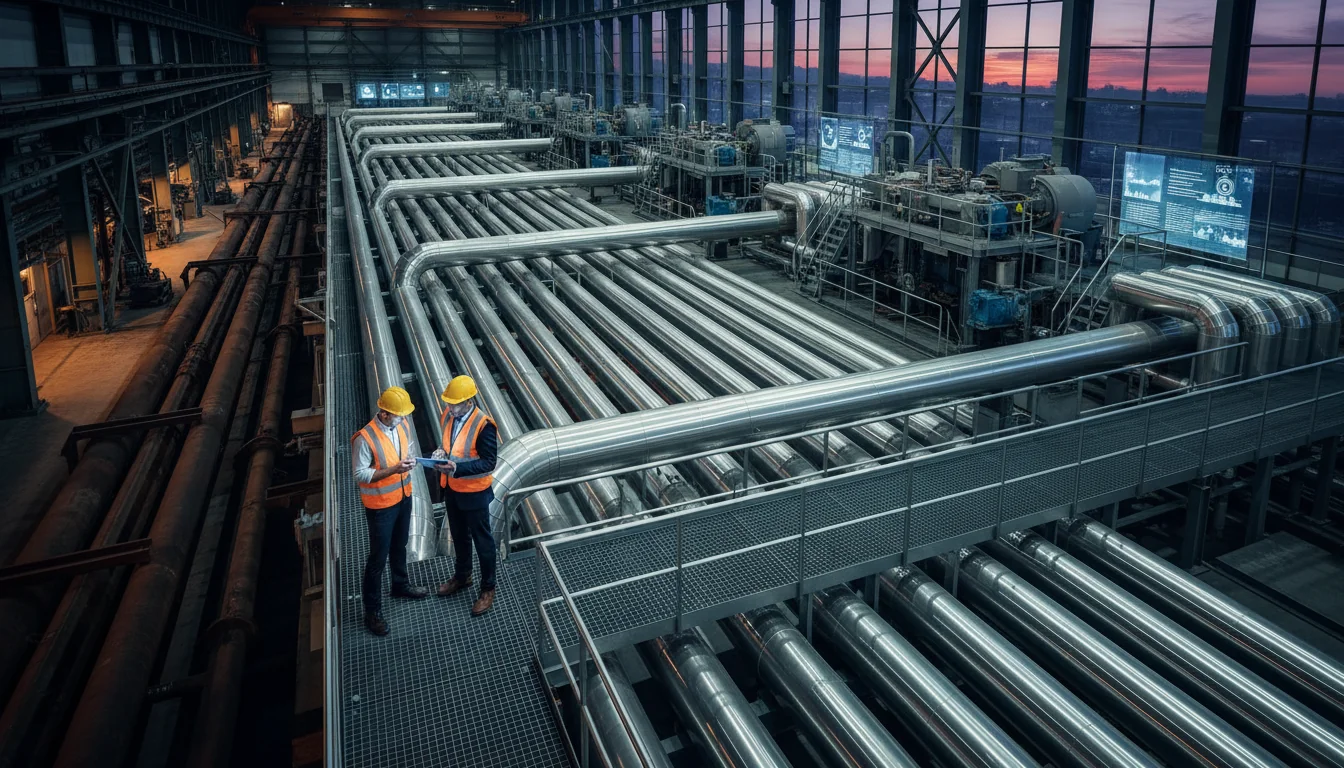
Boilleo Private Limited works at exactly this intersection of design, erection, and lifecycle performance. By treating process piping as a strategic asset—not an afterthought—we routinely uncover 15–20% OPEX savings opportunities in power cycle piping, steam generation loops, and boiler islands.
Designing Process Piping for Lower Pumping Loads and Energy Use
Energy waste in process piping is rarely dramatic; it’s death by a thousand pressure drops. Each unnecessary elbow, undersized line, and rough internal surface adds head loss that pumps must fight every hour of operation. Over a decade, those design compromises can cost more than the entire initial piping package. In thermal power plants, even a 1–2% reduction in auxiliary power consumption meaningfully improves heat rate and dispatch competitiveness.
Smarter industrial piping solutions start with hydraulics, not routing convenience. That means right-sizing pipe diameters using lifecycle cost curves, minimizing fittings and sudden contractions, and standardizing on low-roughness materials and clean internal welds. In high-energy steam and condensate lines, well-designed drainage, supports, and expansion loops prevent water hammer and fatigue that degrade efficiency. Boilleo’s power cycle piping solutions model pressure profiles across the full operating envelope, then iterate layouts to reduce pump head requirements by 5–10% without compromising maintainability.
For new builds, this design discipline typically pays back in 2–4 years via reduced auxiliary consumption. For retrofits, targeted re-routing of high-loss circuits—especially boiler feedwater, condensate, and cooling water—can unlock similar returns without full-scale replacement.
Eliminating Leaks and Downtime Through Constructability and Quality Control
Every leak is a thermodynamic penalty and an operational risk. In high-pressure steam generation and boiler islands, minor weeps escalate into forced outages, emergency repairs, and safety incidents that dwarf any savings from low-bid installation. Global benchmarks suggest that piping-related issues can account for 20–30% of unplanned boiler and turbine trips in aging plants.
High-ROI process piping installation therefore blends engineering with constructability. Boilleo’s approach starts with isometrics designed for weld access, NDT coverage, and safe erection sequencing—critical in congested power houses and industrial facilities. We prioritize weld joint reduction through pre-fabricated spools, rigorous WPS/PQR regimes, and automated welding where feasible to improve consistency. On-site, integrated QA/QC—hydrotesting, radiography, and phased array UT—catches defects before commissioning converts them into chronic leaks.
For Indian operators under pressure to maintain availability, the value is concrete: fewer minor leaks mean less steam loss, reduced makeup water and chemical treatment, and—most importantly—fewer boiler outages. Over 10 years, a plant can reclaim weeks of productive hours and avoid repeated scaffolding, insulation removal, and rework on the same problem lines.
Integrating Piping, Boiler Installation, and Industrial Construction for Maximum ROI
Real OPEX optimization happens when process piping, boiler installation, and plant erection are engineered as one system. Fragmented contracting—different vendors for boilers, piping, civil works, and cabling—creates interface risk, misalignment on tolerances, and costly field adjustments. Each workaround becomes a future maintenance headache.
Boilleo Private Limited’s integrated model—covering power cycle piping solutions, boiler islands, mechanical erection, civil manpower supply, and installation of electrical and telecommunication plants—reduces that friction. By aligning stress analysis, support design, boiler nozzle loads, and structural steel from the outset, we cut site clashes and temporary fixes that later leak, vibrate, or corrode. Coordinating illumination and signaling systems within the same 3D environment further de-risks maintenance access and outage planning.
For developers and industrial operators in India, the commercial impact is straightforward: shorter commissioning schedules, smoother reliability runs, and lower lifetime maintenance intensity. When OPEX projections are fed back into project finance models, integrated industrial construction companies like Boilleo can often demonstrate 15–20% lower lifetime piping-related costs versus conventional, fragmented delivery.
Frequently Asked Questions
What is process piping installation in a power plant context?
Process piping installation in power plants covers the full lifecycle of designing, fabricating, erecting, and testing piping systems that move steam, feedwater, condensate, fuel, cooling water, and auxiliary fluids. It includes routing, stress analysis, selection of materials and supports, welding and NDT, insulation, and integration with boilers, turbines, pumps, and balance-of-plant equipment. Unlike simple utility piping, process piping must meet stringent codes, withstand high temperature and pressure cycles, and maintain tight leak-rate tolerances. In modern Indian power and industrial facilities, it also interfaces with instrumentation, telecommunication, and safety systems. A disciplined installation strategy focuses not only on meeting initial specifications, but on minimizing lifetime energy losses, leaks, and maintenance interventions.
How do I calculate the ROI of upgraded process piping installation?
To calculate ROI, start by establishing baseline costs: annual auxiliary power consumption for pumps/fans, historical leak and repair expenses, and outage hours traceable to piping issues. Next, estimate improvements from optimized piping: percentage reduction in pump head, expected drop in leak incidents, and avoided outage hours. Convert these into annual rupee savings using your tariff, fuel cost, and maintenance rates. Then compare against the incremental CAPEX of higher-spec piping design and installation. A simple discounted cash flow over 10–15 years will show payback period and IRR. Boilleo often supports clients by running sensitivity analyses on multiple scenarios—new units, retrofits, and selective circuit upgrades—to prioritize packages with the strongest economic case.
Why are inefficient power cycle piping solutions so expensive over time?
Inefficient power cycle piping solutions silently tax the plant every operating hour. Excessive pressure drops force pumps to consume more power, raising auxiliary load and degrading heat rate. Poor drainage or slope design in steam and condensate lines accelerates corrosion and erosion, leading to leaks and frequent weld repairs. Inadequate flexibility and support layouts trigger vibration, nozzle overloads, and fatigue cracks. Each symptom adds energy, water, chemical treatment, and labour costs, while also increasing forced outage risk. Over a decade, these incremental penalties can exceed the original cost of the piping system. That is why seeing piping purely as a CAPEX commodity—rather than as a strategic efficiency asset—inevitably produces higher lifetime OPEX and lower plant availability.
How can industrial facilities in India choose the right partner for industrial piping solutions?
When evaluating partners for industrial piping solutions, look beyond lowest price. Assess their track record in power plants, refineries, or process industries with similar pressures and temperatures. Ask for case studies quantifying reductions in auxiliary power, leaks, or outage hours. Review their in-house capabilities: 3D modelling, stress analysis, welding procedure development, NDT, and integration with boiler installation and civil works. In India, it is especially valuable to work with companies like Boilleo that also handle illumination, signaling, and telecommunication plants, ensuring fewer interface gaps. Finally, evaluate their safety culture and commissioning support; a partner willing to stand behind performance during reliability runs is far more likely to design and install piping with lifecycle ROI in mind.
When does it make sense to retrofit existing piping instead of full replacement?
Full replacement is rarely necessary. Targeted retrofits make sense when diagnostics reveal a small number of circuits driving most of the losses or failures—for example, high-head boiler feedwater lines, problematic condensate returns, or recurrent leak points around boiler headers. Start with a hydraulic and stress audit to map where pressure drops, vibration, or thermal movements are worst. Then prioritise rerouting to reduce fittings, upsizing selected segments, adding supports or expansion loops, and upgrading critical welds. These focused interventions often deliver 60–80% of the potential OPEX savings at a fraction of replacement cost, with minimal outage time. Boilleo typically integrates such retrofits into planned maintenance or boiler overhauls to further reduce production impact.
Conclusion and Next Steps
For power plants and industrial facilities, process piping installation is one of the few levers that simultaneously improves efficiency, reliability, and safety. Treating it as a strategic investment—not a commodity—can unlock 15–20% lifetime OPEX savings and materially shift project returns. The path forward is clear: start with data on pumping loads, leaks, and piping-related outages; commission a focused hydraulic and constructability review; and then prioritise high-impact circuits for redesign or retrofit. Developers and operators in India seeking bankable improvement should engage an integrated partner capable of piping, boiler installation, and plant erection under one technical philosophy. Boilleo Private Limited is structured precisely for this role—aligning engineering, installation, and maintenance realities to turn industrial piping solutions into a durable competitive advantage.
process piping installationinefficient power cycle piping solutionsindustrial piping solutions