It seems we can’t find what you’re looking for. Perhaps searching can help.
Power Plant Downtime Solutions During Upgrades: Phasing, Bypasses and Hot Work Strategies
power plant downtime solutionspower plant equipment failure repairaging power plant infrastructure upgradeindustrial plant installation
Every plant owner knows the uncomfortable truth: the grid may be 24/7, but your assets are not. Aging boilers, tired piping, and obsolete controls quietly erode reliability until a forced outage makes the problem public and painfully expensive. The strategic question is no longer whether to upgrade, but how to minimise power plant downtime during upgrades without jeopardising safety or generation commitments.
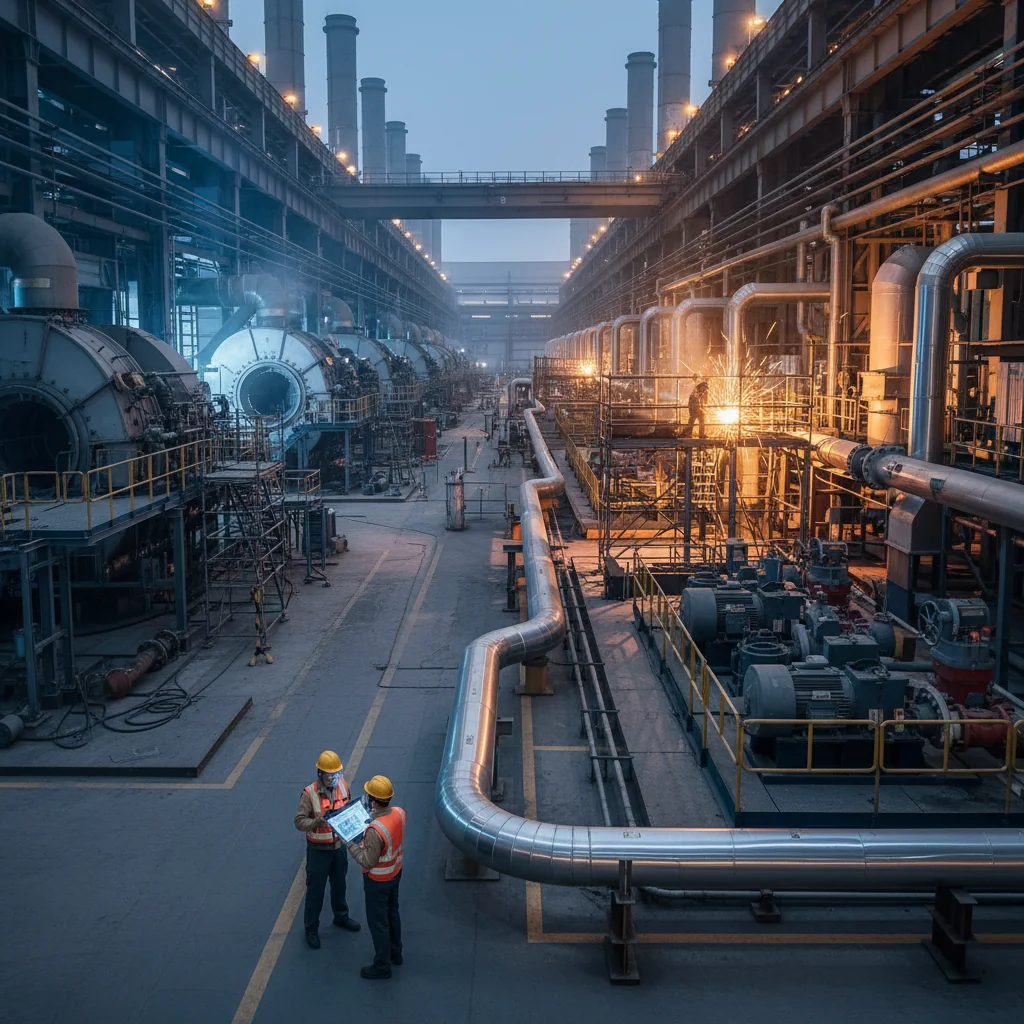
This is where advanced outage planning, smart phasing, temporary bypass systems, and disciplined hot work management turn into competitive weapons. Plants that master these tactics cut upgrade-related downtime by 20–40%, extend asset life by 10–15 years, and reduce unplanned trips—while keeping regulators, utilities, and financiers comfortable.
Drawing on field experience from Indian projects across thermal, industrial captive, and cogeneration plants, this article breaks down practical power plant downtime solutions. It also shows how specialised partners like Boilleo Private Limited—with deep capabilities in industrial process piping, power cycle piping, boiler installation, and electrical/telecom plants—help owners execute complex upgrades with surgical precision.
If you’re reshaping strategic capex for aging power plant infrastructure upgrades, this is your playbook.
1. Why downtime is the real cost driver in power plant upgrades
The primary cost in many upgrades is not the equipment; it is the lost megawatt-hours during outage. A 500 MW coal unit offline for 10 extra days can erase any savings wrung out of procurement. Understanding this math is the first step to serious power plant downtime solutions.
For IPPs, every additional outage day compounds lost generation revenue and PPA penalties. For industrial captives and process plants, downtime hits both energy and core production: furnaces idle, lines stop, and backup diesel costs spike. In India, where grid stability and fuel linkages are variable, scheduled outages can quickly turn into high-stakes gambles if not meticulously managed.
Three structural trends are making the downtime question more urgent:
- Aging fleets: Many Indian plants are 15–30 years old, with life-extension decisions overdue.
- Tighter emissions norms: SOx/NOx/PM controls require major retrofits in boilers and flue gas paths.
- Volatile demand: Industrial customers expect near-continuous supply despite these constraints.
In modern retrofit projects, the true ROI comes from downtime avoided, not just efficiency gained.
This shifts the focus from one-time EPC cost to execution strategy: sequencing, constructability, pre-fabrication, and parallel work streams. Owners who still treat downtime as a secondary issue, or who award purely on L1 pricing, increasingly find themselves with overrun outages and unhappy stakeholders.
2. How to minimise power plant downtime during upgrades: the four-part blueprint
The most reliable way to minimise power plant downtime during upgrades is to integrate engineering, construction, and operations into a single, phased execution plan. In practice, leading plants follow a four-part blueprint.

1. Front-load engineering and constructability
Detailed 3D scans, clash detection, and constructability reviews ensure new boiler or piping systems can be slotted into tight existing spaces. Boilleo’s work on industrial steam generation projects typically reduces on-site rework by 20–30% using this approach.
2. Maximise off-site prefabrication
Power cycle piping spools, valve manifolds, structural supports, and even skid-mounted auxiliary systems are fabricated and pre-assembled off-site. On site, execution becomes predominantly bolt-up and tie-in, not field fabrication.
3. Design for parallel work paths
Electrical, mechanical, and civil work are sequenced so that critical-path activities (like main steam line cut-in) are tightly time-boxed, while non-critical activities proceed in parallel with operation or partial load.
4. Embed contingency and decision gates
High-risk interventions (major hot work, pressure part replacement) are preceded by go/no-go gates with clear quality criteria and backup plans (temporary bypasses, alternative supply).
The most effective downtime reduction strategies treat outages as precision operations, not as flexible windows of convenience.
Partners with integrated mechanical solutions, industrial piping, and civil manpower—like Boilleo—are particularly valuable because they can orchestrate this blueprint end-to-end rather than patching work package by work package.
3. Phasing strategies for power plant retrofit projects: turning one big outage into many small ones
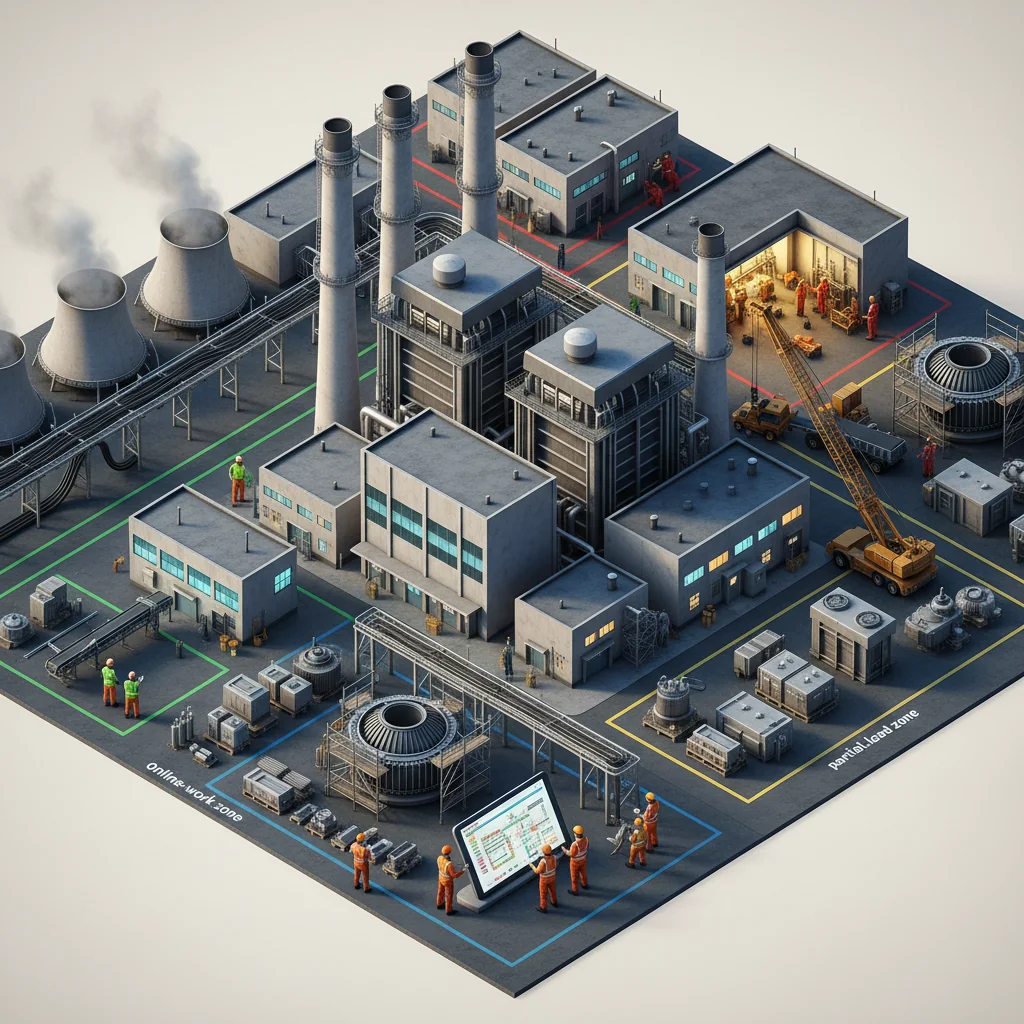
Phasing strategies for power plant retrofit projects are about breaking a single, long outage into multiple, shorter interventions, each tightly scoped and optimised. When done well, phasing can cut net downtime by 25–35% without diluting safety.
Define the phasing logic
Effective phasing starts by categorising work into:
- Online work: Can be executed at load (e.g., cable routing, scaffold erection outside hot zones).
- Partial-load work: Requires reduced load but not full shutdown (e.g., some balance-of-plant piping tie-ins).
- Cold outage work: True shutdown activities (e.g., main steam header replacement, boiler pressure-part interventions).
Build a phase-wise roadmap
- Phase 0 – Enabling works: Civil foundations, access platforms, and cable trays installed while the unit runs.
- Phase 1 – Parallel systems: New lines, supports, and equipment installed "cold" alongside existing systems.
- Phase 2 – Cut-over: Short, focused outages for tie-ins, hot work, and pressurisation.
- Phase 3 – Optimisation: Post-commissioning fine-tuning, often at partial load.
On complex boiler and power cycle piping projects, Boilleo typically maps phasing down to shift-level activities, with clear handovers between mechanical, electrical, and instrumentation teams. This granular approach is especially useful in multi-unit plants: one unit can provide captive or export power while another undergoes a high-intensity Phase 2 cut-over.
Well-designed phasing converts outage windows from vague estimates into hour-by-hour commitments.
4. Designing bypasses and temporary systems that keep plants earning while you upgrade
Bypass and temporary systems are among the most underrated power plant downtime solutions. A bypass system is a temporary path—typically for steam, water, fuel, or flue gas—that allows part of the plant to keep running while a critical subsystem is offline.
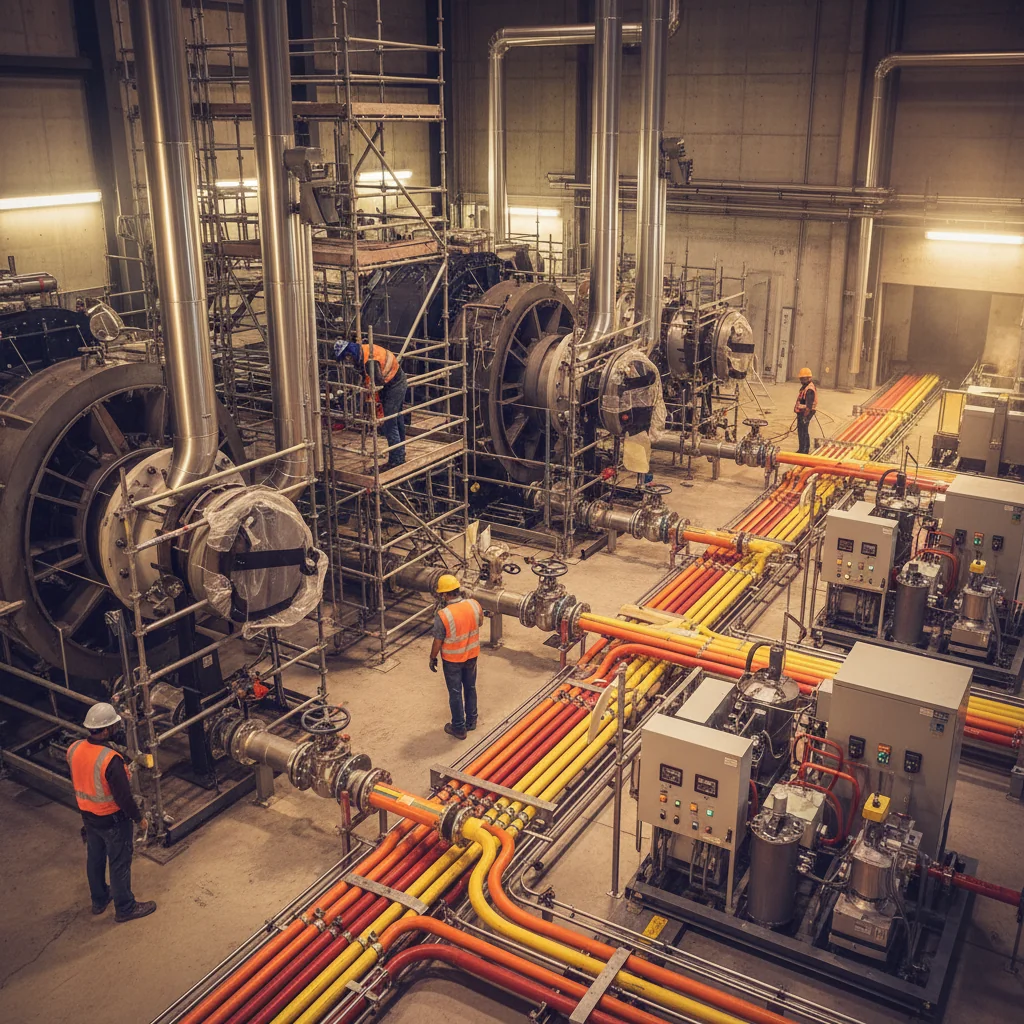
Common bypass strategies include:
- Steam bypass to condenser: Enables turbine isolation while the boiler or main steam piping is modified.
- Fuel system bypass: Temporary lines and skids to feed auxiliary boilers or process heaters.
- Cooling water diversions: Let certain heat exchangers be isolated without shutting the loop.
- Electrical bypass/temporary feeders: Maintain power to critical auxiliaries while switchgear or transformers are upgraded.
Designing these systems requires the same rigor as permanent installations: pressure ratings, flexibility, supports, and safety valves must comply with codes. Boilleo’s expertise in industrial process piping and power cycle piping comes into play here—building temporary lines that are both safe and rapidly deployable.
A typical workflow:
- Identify load levels that must be maintained (e.g., 40% TMCR to serve captive demand).
- Map process bottlenecks and where temporary paths could be inserted.
- Engineer and pre-fabricate bypass spools and skid units in advance.
- Install during enabling phases; activate only during cut-over.
The smartest plants treat bypasses not as improvisations but as engineered products within the retrofit scope.
5. Hot work management during power plant upgrades: controlling the highest-risk hours
Hot work management during power plant upgrades is where many outages win or lose their safety record. Hot work is any operation involving open flames, sparks, or heat—welding, cutting, grinding—that can ignite flammable materials or damage adjacent assets.
Because hot work is unavoidable in boiler maintenance, power plant equipment failure repair, and major piping replacement, the goal is not elimination but tight control. A robust framework typically includes:
- Centralised hot work permitting: A single permit office validates isolation, gas-free status, and fire watch arrangements before work begins.
- Zone classification: Ex-rated areas, fuel handling zones, and cable galleries have stricter conditions or alternate methods (cold cutting, flange replacements).
- Time-boxing critical welds: Scheduling high-risk welds during low-load windows with full emergency response readiness.
- Pre-fabrication to reduce on-unit welds: More shop welding, fewer field welds near live systems.
Partners like Boilleo, who routinely execute industrial piping and boiler installation projects, bring standardised welding procedures, WPS/PQR documentation, and certified welders. This reduces the likelihood of rework—which is itself a major downtime driver.
In most upgrade outages, fewer than 10% of job-hours are hot work—but they carry more than 80% of the catastrophic risk.
Well-run plants integrate hot work management into outage phasing, not as an afterthought: critical welds are sequenced early to leave time for NDT, PWHT, and any necessary repairs without extending the outage envelope.
6. From emergency repair to lifecycle strategy: reframing power plant equipment failure repair
Power plant equipment failure repair is often treated as firefighting—a scramble to restore capacity. But leading operators in India are reframing it as an entry point into structured lifecycle extension strategies, especially for industrial steam generation and boiler maintenance services.
Instead of a like-for-like replacement of failed components, the smarter play is to ask three questions:
- What does this failure reveal about systemic risk? Tube leaks, valve seizures, and header cracks usually point to broader degradation or design weaknesses.
- Can we bring forward planned upgrades? If a forced outage has occurred, can emission-control retrofits, instrumentation upgrades, or control logic modernisation be partially advanced?
- Can we redesign for maintainability? Introducing better access, modular spools, or improved isolation can shrink future outage windows.
Boilleo’s industrial construction experience in India shows that integrating emergency repair with medium-term retrofit plans can cut cumulative downtime over five years by 15–25%. Civil and mechanical modifications—new platforms, revised routing, or rerated supports—pay back quickly once repeat maintenance cycles are considered.
This is also where data and SEO-focused informational content intersect with operations: plants that systematically document failure patterns and repair histories are better positioned to plan capex, justify upgrades to boards and lenders, and choose partners based on lifecycle value rather than lowest initial cost.
Every failure is a data point. The best operators convert it into better design, better access, and shorter future outages.
7. Choosing the right partners for complex industrial plant installation in India
Downtime-optimised upgrades depend heavily on execution capability. For complex industrial plant installation in India—especially around boilers, steam generation, and power cycle piping—the right partner mix often makes the difference between a text-book outage and a reputational crisis.
Key evaluation criteria include:
- Domain depth: Experience in boiler installation, industrial steam generation, and allied systems (fuel, ash, cooling, electrical).
- Integrated services: Ability to combine mechanical solutions, civil manpower supply, electrical and telecommunication plant installation, and radar/illumination systems when projects span multiple disciplines.
- Phasing and constructability track record: Documented cases of phased retrofits, bypass implementations, and compressed outage delivery.
- Quality and welding controls: Robust WPS/PQR, NDT capabilities, and history of defect-free power cycle piping.
- Safety culture: Demonstrated hot work management, permit-to-work discipline, and low TRIR.
Boilleo Private Limited, operating across these dimensions in the Indian market, positions itself not just as a contractor but as a downtime partner: designing installations and retrofits with future outages, access, and maintainability in mind.
In a grid and industrial ecosystem that demands near-continuous operation, your real competitive advantage is a partner who can upgrade without stopping the clock.
For asset owners planning aging power plant infrastructure upgrades, the strategic next step is clear: make downtime reduction—through phasing, bypasses, and hot work excellence—the central KPI of your next capex cycle, and choose partners whose portfolios prove they can deliver on it.
Frequently Asked Questions
How can I minimise power plant downtime during boiler upgrades?
The most effective way to minimise downtime during boiler upgrades is to shift work off the outage path. Start with detailed 3D surveys and constructability reviews, then maximise off-site prefabrication of pressure parts, supports, and power cycle piping spools. Next, design a phased plan: enabling works with the unit online, parallel installation of new systems, and a short, tightly controlled cut-over outage for tie-ins and commissioning. Finally, engineer temporary bypasses or auxiliary steam sources if you must maintain part-load supply. Working with integrated partners like Boilleo, who cover mechanical, civil, and electrical scopes, significantly reduces coordination delays that often extend outages.
What are the most effective phasing strategies for power plant retrofit projects?
Effective phasing strategies start by categorising each activity as online, partial-load, or cold-outage work. From there, create a phase-wise roadmap: Phase 0 for civil and access enabling works; Phase 1 for installing new lines, supports, and equipment while the existing system operates; Phase 2 for short, high-intensity cut-over outages; and Phase 3 for post-commissioning optimisation. Each phase should have clear entry/exit criteria, resource plans, and contingency steps. Phasing works best when engineered early, not after EPC award, and when your installation partner is comfortable operating around live systems and tight windows.
How should hot work be managed during power plant upgrades?
Hot work management during upgrades should be treated as a dedicated program, not a set of isolated permits. Establish a central hot work permit office that verifies isolations, gas-free status, and housekeeping before authorising tasks. Classify zones by risk and restrict or adapt hot work in fuel, oil, and cable-heavy areas. Time-box critical welds to low-risk periods with full fire watch and emergency readiness. Maximise shop welding and use pre-fabricated spools to reduce the number of field welds in congested, high-risk spaces. Finally, insist on certified welders, documented WPS/PQR, and timely NDT to avoid rework that can blow the outage schedule.
When should I choose bypass systems instead of full shutdown for upgrades?
Bypass systems are ideal when you must keep some level of generation or process steam supply while upgrading critical equipment. Use them when customers cannot tolerate a full shutdown, when grid conditions are tight, or when outage windows are constrained by fuel and seasonal factors. Common examples include steam bypass to condenser to isolate the turbine, temporary fuel lines to auxiliary boilers, or cooling water diversions to keep part of the loop running. The decision hinges on whether temporary systems can be engineered to meet safety and code requirements while delivering enough capacity to justify the additional cost and complexity.
Why is partnering with an integrated industrial construction company important for downtime reduction?
Downtime reduction depends on eliminating interfaces that create delays. An integrated industrial construction company in India—one that provides mechanical, civil manpower supply, power plant and transformer installations, industrial piping, and even illumination and signalling systems—can coordinate all outage-critical scopes under one plan. This avoids disputes over access, scaffold ownership, or sequence that often extend outages. It also enables holistic phasing, where civil, mechanical, and electrical works are sequenced to support each other. Companies like Boilleo bring lessons from multiple sectors—power, industrial plants, and infrastructure—allowing them to apply best practices in constructability, hot work control, and bypass design across projects.
Conclusion
Power plant owners in India are entering a decisive decade: aging assets, tighter norms, and unforgiving customers make poorly managed outages unaffordable. The plants that win will be those that treat downtime as a core design variable, not a by-product—using rigorous phasing, engineered bypasses, and disciplined hot work management to keep megawatts and process steam flowing even as they upgrade.
For boards and plant heads planning their next capex cycle, the mandate is direct: demand outage strategies as detailed as equipment datasheets, and choose partners—like Boilleo Private Limited—whose execution history shows they can deliver upgrades at the speed your market now requires.
power plant downtime solutionspower plant equipment failure repairaging power plant infrastructure upgradeindustrial plant installation